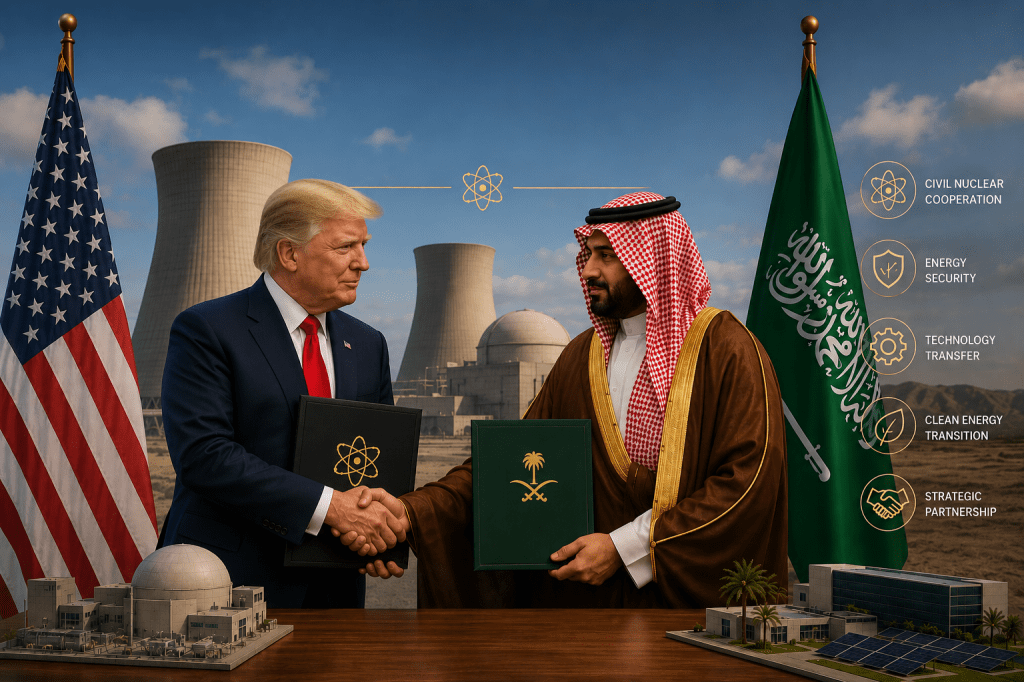
SAUDI ARABIA WILL ENRICH URANIUM WITH TRUMP’S PERMISSION. BUT WASN’T IRAN THE PROBLEM?
‘Why does Saudi Arabia need to enrich uranium on its home soil? The answer isn’t complicated: It doesn’t unless it would like to establish the rudiments of a nuclear-weapons program as a contingency. The more difficult question to answer is why the Trump Administration is going along with it’.
These are the words of “Wall Street Journal” (23 July 2026, A14). The New York-based financial newspaper has revealed that Trump has just signed a civil nuclear agreement with Saudi Arabia, securing new contracts for US companies and sacrificing measures adopted in 2009 to safeguard nuclear non-proliferation.
The recent US–Saudi Arabia agreement deviates from the ‘benchmark’ for non-proliferation. Until now, this benchmark had prohibited the enrichment of uranium and the reprocessing of plutonium on national territory. Now, however, the agreement provides for a two-year study, to be conducted by the United States and Saudi Arabia, into the value and commercial viability of enriching Saudi uranium, at the end of which a decision will be taken.
‘What’s to study? Everyone knows it isn’t cheaper to begin enriching over there. But commissioning a study is a Washington dodge, and Congress will want to know whether the Administration is stringing it along with a formality.”
The above also represents a break with a bipartisan American tradition: halting the proliferation of enrichment processes, whether for friends or foes. Now, however, Saudi Arabia will be free to enrich its own uranium with Trump’s blessing.
Another of the President’s weakened tools is monitoring in accordance with the Additional Protocol of the IAEA in Vienna, the International Atomic Energy Agency. The United Arab Emirates have signed it, thereby accepting the ban on uranium enrichment, in accordance with the nuclear agreement between the UAE and the US under George W. Bush, signed in 2009. But now Trump has allowed the Saudis to enrich their uranium, and thus to withdraw from the Additional Protocol with the very support of the United States.
In his generosity, Trump has explained that the agreement with the Saudis contains safeguards. But will the Saudis accept a stricter monitoring regime?
No. It follows that the controls will be lax.
A chain reaction is then almost certain. ‘Every US ally will be able to push for its own preferential monitoring arrangements.’
But who will be next to negotiate ‘tailor-made’ uranium enrichment with Washington? Turkey and Egypt, perhaps (isn’t Trump practically Erdogan’s yes-man?). And the United Arab Emirates, a far better US ally than the Saudis, who will not want to be the only ones adhering to the old monitoring regime.
The result: “ It will be far more difficult to prevent nuclear enrichment capability from spreading across the volatile region” such as the Middle East.
Even Biden, before Trump, had held out the prospect of nuclear cooperation to the Saudis as a reward if they joined the Abraham Accords.
But the Saudis did not want to sign up to those agreements, and now Trump is rewarding them without renewing that essential condition, namely recognising the State of Israel. “One has to hope the Saudis have offered something more.”
The moral of the story? “Trump made the hard decision to fight in Iran but flunks the easier one”.
 WEI - WORLD EVOLUTION INSTITUTE